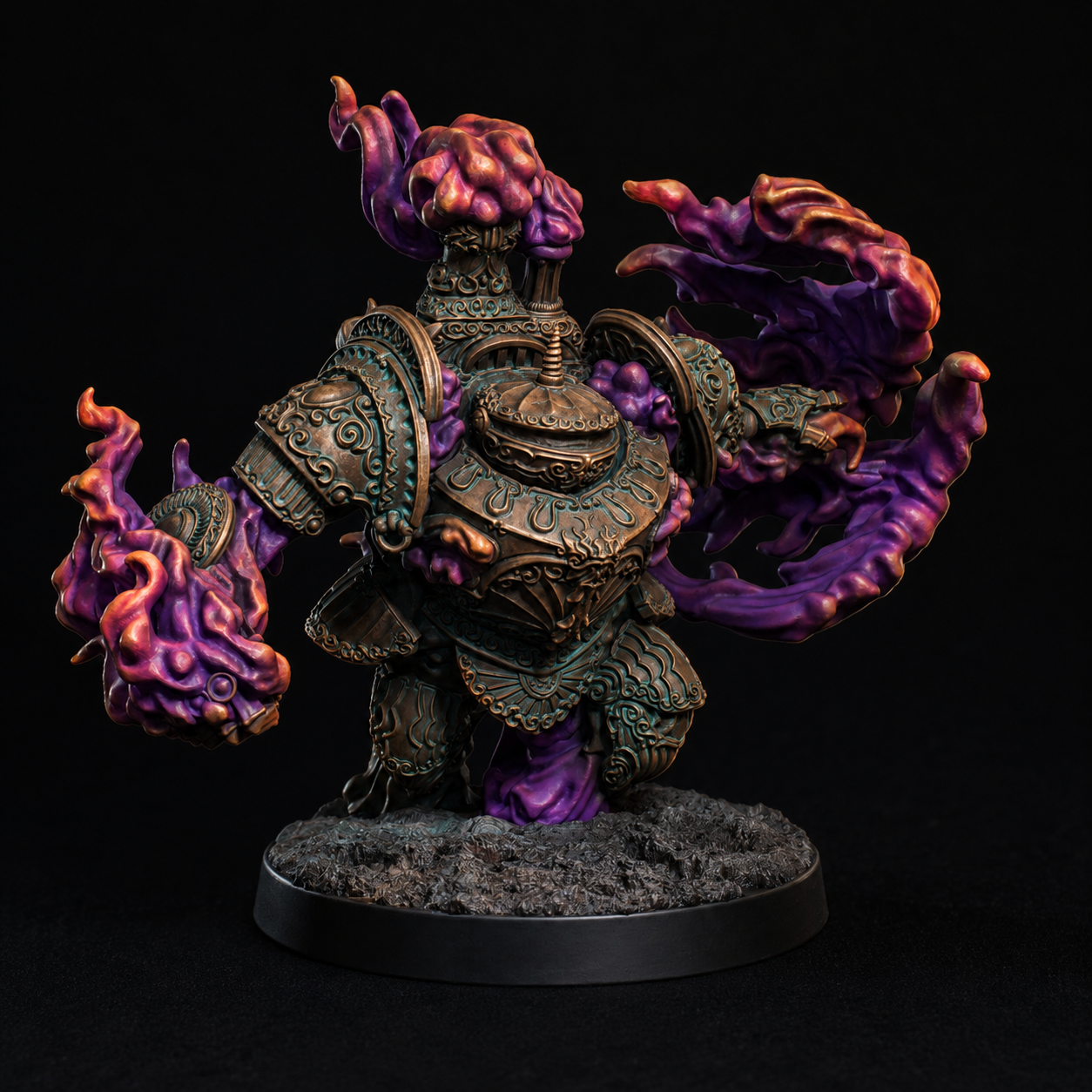
Eidolem: The Empty Vessel
An Eidolem origins story
The Work of Zaron
Long before Eidolem first opened his eyes, Zaron had already devoted much of his life to the pursuit of immortality. Necromancy offered obvious possibilities, but Zaron had little interest in preserving himself as a corpse. Undeath might extend existence, yet decay still clung to it, reducing even the most powerful revenant to a thing that endured rather than truly lived. Zaron wanted something more complete: a way to preserve the mind without accepting the indignities of a failing body.
His early experiments turned toward a union of sorcery and arcane machinery, replacing vulnerable portions of the mortal form with mechanisms that could neither age nor sicken. Styx became the greatest product of that work. Piece by piece, Zaron altered him, removing damaged or unreliable flesh and replacing it with intricate mechanical substitutes bound directly into the body through necromantic craft. Metal joints replaced bone, artificial mechanisms assumed the work of organs, and arcane conduits carried sensation where living nerves could no longer survive.
The result was something unprecedented, a living man whose continued existence depended as much upon machinery as flesh.
To Zaron, however, Styx represented an interesting failure rather than a triumph. His altered body still required maintenance, and although metal had replaced much of the flesh that aged and weakened, corrosion had merely taken the place of disease while pain remained stubbornly unchanged. More damning than any practical flaw was the simple fact that Zaron found the result ugly. Whatever immortality he eventually claimed, he would not spend eternity as a patchwork of flesh, iron, tubing, and arcane mechanisms.
His interest moved elsewhere, but Styx remained in his service. A loyal servant who was difficult to kill still had considerable value.
Styx understood their relationship very differently. Over years of service, admiration had deepened into something perilously close to filial devotion. Zaron was master, mentor, and creator, the man responsible for everything Styx had become. Where Zaron saw an abandoned experiment, Styx saw unfinished work. If his transformation had failed to satisfy his master, then the fault could only be that the transformation had not gone far enough.
And so Styx continued the work that Zaron had abandoned.
The Perfect Vessel
Mideon offered Styx opportunities that had never existed in Athien. Throughout the necropolis, souls gathered around forgotten tombs and shattered monuments, drawn toward places where death had worn the boundary between spirit and matter thin. In such a realm, the soul was not an abstraction of theology but something that could be observed, manipulated, bound, and transformed.
For Styx, this abundance of spiritual energy suggested a solution to the final weakness of Zaron's experiments. The mistake had been trying to preserve the mortal body at all. Flesh did not need to be repaired indefinitely if it could simply be discarded. Deep beneath the necropolis, in chambers so ancient that their original purpose had been forgotten, Styx began constructing an artificial body capable of housing a living consciousness. This was no crude automaton designed to follow commands. Every part of the construct was intended to replace some function of mortal anatomy while exceeding its limitations. Its frame was built from interlocking arcane mechanisms and heavy armour capable of surviving wounds that would destroy a living warrior. Artificial musculature gave it tremendous physical strength, while finely engraved channels carried soul energy through its limbs in place of blood.
Styx called the creation Eidolem.
To Styx, Eidolem was beautiful precisely because it lacked everything he had come to hate in himself. There were no remnants of weak flesh caught between metal plates, no organs requiring constant protection, and no painful divide between the man he had once been and the machinery keeping him alive. The new body would not be repaired piece by piece because there would be nothing mortal left to preserve.
Yet one problem remained. Machinery could be made to move and respond, but movement was not life. An artificial body might imitate thought without possessing consciousness of its own, and Styx had no intention of spending eternity imprisoned inside an elaborate puppet.
His solution required a soul.
The ritual he devised was both ingenious and horrifying. A soul would be bound permanently within Eidolem, providing the living spiritual essence necessary to animate the construct. Its memories and identity would then be stripped away, leaving only the deepest foundations of existence: awareness, instinct, emotion, and the primal desire to survive. Once that foundation had been secured, Styx would transfer his own consciousness into the vessel.
The soul would give the body life. The machine would give it permanence. Styx would provide the identity.
If successful, nothing meaningful would remain of his old body. For the first time, Styx would exist without decay, without the constant maintenance of his implants, and without the physical evidence of Zaron's abandoned experiments written across his flesh.
More importantly, he believed he would finally have proven himself worthy of the man who created him.
Zaron's Betrayal
Zaron discovered Eidolem before the final ritual could be completed.
What he found disturbed him for reasons that had little to do with morality. His servant had taken discarded research and transformed it into something that appeared dangerously close to success. Styx had accomplished what Zaron himself had failed to achieve, using knowledge that Zaron considered an extension of his own genius.
The discovery awakened a possessiveness that Zaron would never have called jealousy. Styx's mechanical body existed because of him. Styx's understanding of arcane technology had grown from his teachings. Even the obsession that drove his servant forward could, in Zaron's mind, be traced back to the experiments they had once conducted together. Whatever Styx had created therefore belonged, in some indirect and unquestionable fashion, to Zaron.
Destroying the project himself would have required acknowledging Styx as a rival. Instead, Zaron chose deception.
Through carefully placed rumours and information allowed to fall into the proper hands, the followers of Ista learned that a servant of Krognar was constructing a terrible weapon within the necropolis. They heard of an artificial warrior sustained by stolen soul energy, a creation of extraordinary strength that might upset the balance of power between the gods if it were allowed to awaken.
Almost everything they were told was true. Only the purpose was a lie.
Saiyin and Raxos were sent to investigate, believing they were moving against a weapon intended for Krognar's wars. Neither knew that they were serving the private resentment of the necromancer who had betrayed the very servant he once created.
The Interrupted Ritual
By the time Saiyin and Raxos reached Styx's hidden laboratory, the final ritual was already underway.
A soul had been bound into Eidolem, and much of what had once defined that soul had already been destroyed. Memories had been torn away and identity reduced to fragments. Whatever mortal life had preceded the ritual was now buried so deeply that almost nothing recognizable remained.
The final transference, however, had not yet taken place. Styx's consciousness still remained within his own body.
Saiyin immediately sensed that something within the construct did not fit the description they had been given. The presence inside Eidolem was damaged and incomplete, but it was not merely energy. Beneath the layers of ritual and machinery there remained awareness, faint and confused, but unmistakably alive.
Raxos had less reason to trust such distinctions. Before him stood an enormous artificial warrior being created in secret by one of Krognar's servants, its body sustained by a soul that had been mutilated for the purpose. Whatever Styx claimed to intend, allowing the ritual to continue presented a danger too great to ignore.
The confrontation rapidly became violent.
Styx defended the laboratory with the desperation of a man protecting not merely years of work, but the future he believed he had earned. He fought through misdirection, arcane technology, and assaults against the mind, forcing his enemies to contend with dangers they could not always see or understand. Raxos answered with overwhelming physical force, driving into the chamber like a living siege weapon and smashing apart machinery whenever he could reach it, while Saiyin worked behind him to unravel the spiritual forces surrounding the construct.
Their battle damaged the mechanisms controlling the ritual, and Eidolem awakened before Styx could enter him.
The Birth of Eidolem
Eidolem's first experience of existence was confusion sharpened immediately into fear.
He possessed no memories with which to understand the chamber around him, no language through which to interpret the sounds of battle, and no identity capable of distinguishing stranger from enemy. The world arrived as sensation without explanation: violent movement, heat, pain, noise, and the terrible realization that the body he had only just become aware of was in danger.
The instinct remaining within the stripped soul responded before thought ever could, and Eidolem tore himself free of the ritual apparatus.
Raxos met the newly awakened construct head-on, and their struggle became a collision between two beings of immense physical power. Raxos fought with the disciplined aggression of an experienced warrior, attempting to contain something he believed could become catastrophic if it escaped the laboratory. Eidolem possessed no such discipline. He fought with the raw and desperate brutality of a creature that had never learned the difference between attack and defence, answering every threat with whatever force his new body allowed him to exert.
For Styx, the awakening was devastating.
The body had worked and the soul had survived, but it had not remained empty. Something had taken root inside the vessel before Styx could occupy it. The soul he had intended to reduce to little more than a source of animation had begun forming an identity of its own, however primitive and confused that identity remained.
Eidolem was no longer waiting to become Styx. He had become someone else.
Recognizing that the transference could no longer be completed, Styx abandoned the laboratory and escaped while Saiyin and Raxos struggled with the creature he had created.
In doing so, Styx repeated the same cruelty that had shaped much of his own existence. Zaron had once discarded him when the experiment ceased to offer the immortality he desired. Now Styx abandoned Eidolem the moment his own creation ceased to serve its intended purpose.
Whether Styx is capable of recognizing the similarity is another matter.
A Soul Without a Past
The battle between Eidolem and Raxos might have continued until one of them was destroyed had Saiyin not realized what lay beneath the construct's violence. Eidolem was not fighting out of allegiance to Krognar, nor was he driven by hatred for the intruders. He was terrified. Everything around him had become hostile at the instant he entered existence, and violence was the only response he had yet been given reason to understand.
Saiyin lowered her weapon and attempted to reach the consciousness buried within the machine.
Her words meant little at first, but her actions required no language. She possessed the ability to attack and chose not to. When Raxos reluctantly followed her lead and ended his own assault, Eidolem encountered one of the first ideas upon which his emerging morality would eventually be built: strength did not always demand violence.
When the fighting ended, Eidolem stood within the ruins of the chamber in which he had been created with almost nothing that could reasonably be called a past. Whatever mortal identity once belonged to the soul inside him had been almost completely erased. There was no homeland he remembered, no family to return to, and no name waiting to be reclaimed. Fragments occasionally surfaced without explanation. A sensation resembling rain against skin he had never possessed. The memory of laughter without any face attached to it. Sudden revulsion at a smell he could not identify, or the inexplicable certainty that some unfamiliar place felt dangerous. Whether these were remnants of the soul's former life, damage created by Styx's ritual, or thoughts invented by a mind struggling to make sense of its own emptiness remained impossible to determine. Eidolem was therefore left with an unusual burden: he would have to construct himself almost entirely from what came next.
The Empty Vessel
Most beings enter the world already surrounded by answers. They inherit language, loyalty, tradition, faith, prejudice, and the accumulated expectations of those who came before them. Eidolem inherited almost none of these things. He possessed enormous strength without any understanding of what strength was for, and he entered a world divided by gods, tribes, ancient grievances, and moral assumptions that everyone around him seemed to regard as self-evident.
To Eidolem, none of them were. He would have to observe them.
Saiyin became one of his earliest examples, showing him that a soul might possess value before it had accomplished anything worthy of that value. Raxos demonstrated that violence could serve protection rather than domination, although the boundary between the two was rarely as clean as anyone wished to believe. Styx taught him, through abandonment, that creation did not guarantee love and that those responsible for giving life could still regard that life as property.
Zaron's influence would emerge later, when Eidolem came to understand the deeper circumstances surrounding his creation. Through Zaron he would confront a more dangerous philosophy: the belief that knowledge grants ownership, and that creating or understanding another being gives one the right to decide what that being should become.
These lessons provide Eidolem with questions rather than answers. His lack of inherited morality makes him capable of examining customs and assumptions that others accept without thought, but it also makes him dangerous. He possesses the strength to impose himself upon the world long before he fully understands why that strength should ever be restrained. Every encounter therefore becomes part of his creation. Every kindness becomes evidence, and every betrayal becomes evidence as well.
Styx built Eidolem to be an empty vessel into which another man's identity could be poured. The ritual failed before that could happen, leaving the vessel to fill itself instead.
What Eidolem becomes will not be determined by the man whose body he was meant to replace, the soul whose memories were stolen to animate him, or the necromancer whose jealousy set the circumstances of his birth into motion.
For the first time in his existence, the choice belongs to him.